


Rabby Chrome Extension: What DeFi Power Users Should Really Know
Misconception first: browser wallets are all the same and security comes down to whether you memorized a seed phrase. That’s a comforting simplification, but it misses the operational risks that actually cause losses in DeFi — blind signing, wrong-chain mistakes, lingering ERC-20 approvals, and poor visibility into what a transaction will do before you click “confirm.” Rabby’s browser wallet (the Chrome/Chromium extension that sits alongside a mobile and desktop client) is interesting precisely because it treats those operational failure modes as first-order design problems.
This explainer digs into how Rabby works under the hood, why the mechanisms matter to a US-based DeFi user juggling multiple chains and dApps, where the design still falls short, and how to decide whether to adopt it as your primary extension wallet. I’ll surface one clear mental model you can reuse: think of modern wallets as three-layer risk stacks (exposure surface, decision support, and custody model), and I’ll show where Rabby strengthens — and where it leaves — the stack.
Mechanisms: what Rabby does differently
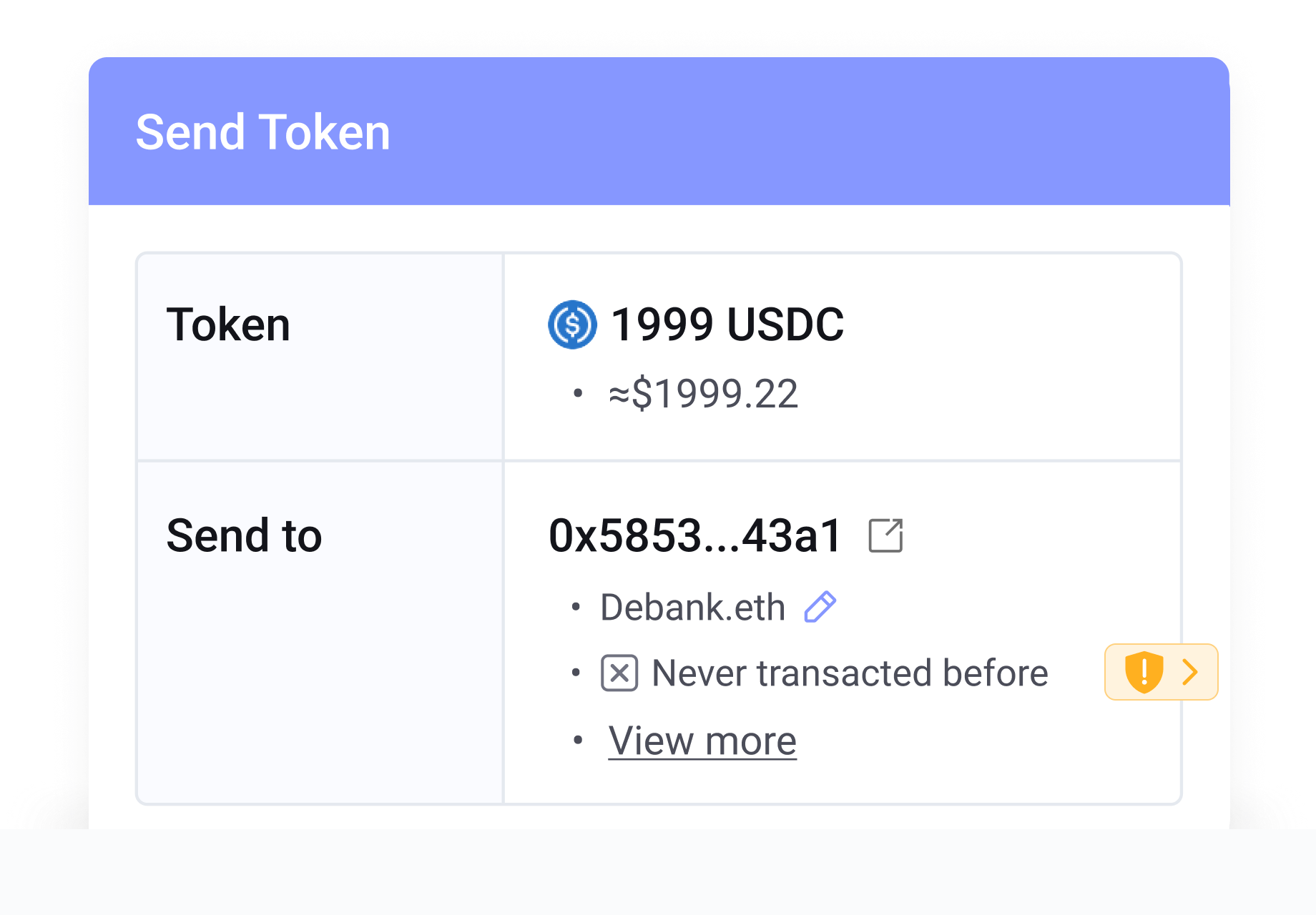
At the mechanical level, Rabby combines several security and usability features that change what “signing safely” actually means in practice. The headline features are pre-transaction risk scanning and transaction simulation. Before any signature is requested, Rabby runs a security engine that flags interactions with known-hacked contracts, suspicious approval requests, or nonexistent recipient addresses. Parallel to that, it simulates the transaction and shows estimated token balance changes and fees — not just a gas number but projected post-transaction balances. For a power user moving funds across liquidity pools or executing complex multisig workflows, that simulation is the difference between blind signing and informed consent.
Operational conveniences are also concrete: automatic network switching means Rabby will detect the dApp you’re using and switch your extension to the correct EVM-compatible chain (one of 90+ supported networks). The wallet also bundles approval revocation tools, multi-sig and institutional integrations (Gnosis Safe, Fireblocks, etc.), and cross-chain gas top-ups to bootstrap activity on a chain where you lack native gas tokens. Those are features aimed at minimizing the friction that traditionally leads users to take risky shortcuts.
Trade-offs and realistic limits
No product eliminates all risk. Rabby is non-custodial and open-source under an MIT license, which invites auditing and community scrutiny — a positive for transparency — but open source alone is not a security guarantee. The wallet’s history includes a 2022 incident where a Rabby Swap contract was exploited for roughly $190k; the team froze the contract, compensated users, and increased audit activity. That sequence illustrates a general point: code can be fixed, but human procedures, integration risk, and third-party contracts remain exposure channels.
Important practical limitations to weigh: Rabby does not offer an in-wallet fiat on-ramp or native staking functionality. If you want to buy crypto with a debit card inside the extension, you’ll need a separate custodian or exchange. Likewise, if you require in-wallet delegation or staking workflows, you’ll rely on external dApps or integrations. Finally, simulation and scanning reduce the chance of mistakes but depend on accurate heuristics and current threat intelligence. Simulations estimate token movements based on current on-chain state; they can be misled by flashloan-based manipulations, race conditions, or rapidly changing mempool activity. In short: Rabby lowers decision risk, but it does not remove systemic or smart-contract risk.
Where Rabby fits in your DeFi toolset
Use the three-layer risk-stack mental model to decide when Rabby is worth the switch. Layer 1: exposure surface — what counterparty or contract is the code touching? Rabby improves visibility here via approval revocation and contract risk flags. Layer 2: decision support — do you have the information to say yes? Rabby’s transaction simulation is a direct improvement at this layer. Layer 3: custody model — who owns the keys? Rabby is non-custodial but offers hardware wallet integrations (Ledger, Trezor, Keystone, and others) and enterprise connectors like Fireblocks, so it can fit both solo operators and institutional setups.
If you currently use MetaMask, think of Rabby as a surgical upgrade in decision support and cross-chain ergonomics: automatic network switching and detailed simulations reduce accidental errors on unfamiliar chains. That said, if you need fiat rails, native staking, or rely on a particular dApp ecosystem that only supports a different wallet, Rabby won’t solve those gaps. Also, for the highest-security custody (cold-storage with air-gapped signing), Rabby is compatible but still relies on the hardware signing device and the user’s operational discipline.
Non-obvious insights and a reusable heuristic
Two points most readers underestimate. First, “blind signing” is not just a buzzword — it is a primary cause of unauthorized transfers. Showing gas alone is insufficient because the malicious permission may transfer tokens that you did not intend. Rabby’s simulation reframes signing as a state-change review: if a signing flow doesn’t produce a clear delta in token balances and recipient addresses, be suspicious. Second, the convenience features that reduce friction (automatic network switching, flip-to-MetaMask toggle) are also attack surfaces when combined with browser-level compromises; using hardware keys eliminates a large fraction of signing risk, but it doesn’t protect you from UI-level phishing if the user approves a malicious contract believing it is legitimate.
Heuristic you can use immediately: for any significant transaction, require three confirmations before signing — (1) UI match (dApp intent vs. wallet request), (2) simulation match (projected balances and fees make sense), (3) source match (contract address verified by independent explorer or audit). Rabby helps with (2) and part of (1); you still need to manually verify (3) especially for new or low-liquidity contracts.
Decision checklist for US DeFi power users
Quick decision framework: if you regularly interact with multiple EVM chains, use hardware wallets, and want stronger pre-signature visibility, Rabby is a solid candidate. If your primary needs are buying crypto with fiat in-wallet or staking to custodial services natively, Rabby will require complementary tools. For institutional contexts, Rabby’s multi-sig and Fireblocks/Gnosis integrations are meaningful; evaluate legal and compliance workflows separately (on-ramps, KYC, and custody policies) before committing.
For hands-on assessment, install the Chrome extension, import a test wallet (never your main seed), connect to a familiar dApp, and run a low-value transaction while watching the simulation. The practical difference in behavior — pausing when a simulation shows an unexpected token delta — is the real test, not feature lists.
What to watch next
Because there is no recent project-specific news this week, monitor three signals over the coming months: (1) security post-mortems and third-party audits following any new feature launches, (2) the fidelity of transaction simulations on complex DeFi flows (are flashloan or sandwich risks being surfaced?), and (3) any expansion of on-ramp or staking partnerships that would fill current product gaps. Each of these will materially change whether Rabby is a full replacement or a specialized companion wallet.
FAQ
Is Rabby safe enough to replace MetaMask as my primary extension wallet?
“Safe enough” depends on what you value. Rabby improves decision support with pre-transaction scanning and simulation, plus better multi-chain ergonomics. For many power users that reduces operational errors more than MetaMask. However, safety also depends on hardware signing, your browser environment, and vetting of the dApps you use. Use Rabby with a hardware wallet to maximize protection.
Can Rabby prevent contract exploits or rug pulls?
Rabby reduces exposure by flagging known bad contracts and allowing you to revoke approvals, and simulations can expose suspicious token movements. But it cannot guarantee protection against novel exploits, vulnerable third-party contracts, or rapid market manipulations. These are ecosystem-level risks beyond any single wallet’s control.
Does Rabby work with Ledger and other hardware wallets?
Yes. Rabby supports Ledger, Trezor, Keystone, CoolWallet, and several other devices, letting you combine its decision-support interface with hardware key security.
Where can I learn more or try the extension?
For a direct starting point, see this resource on rabby which aggregates official links and installation guidance.
